
Sustainable fashion in the Netherlands: how we choose, what it costs, three pieces
You searched for sustainable fashion in the Netherlands and found an online store with a desk in Amsterdam and no shop window. Here is what that store can honestly tell you: how it chooses, what the pieces cost, where they are sent from (measured, not promised), and three pieces you can try on your own avatar before you pay.
Sustainable fashion in the Netherlands, the honest version
The Dutch have written this subject up better than any shop can. If you want a street address, The Green List keeps a national list of sustainable brands and shops, I amsterdam lists the city's own sustainable stores, and Good On You rates Dutch brands one by one. Go there for the shops. We would only be copying them.
What we are is an online store based in Amsterdam that sells across the EU. We do not own a factory, we do not weave anything, and we are not going to use the word sustainable as a coat of paint. What we can do is show you the facts we actually hold about each piece, and let you try it on your own body before you order.
How we choose, and what we say on the label
Three rules, all checkable on the product page.
The fibre is printed. Every piece from our EU makers carries its composition as the maker gave it to us. The cotton crew below is cotton 90%, polyester 10%. The cable-knit turtleneck we sell for €30.99 is acrylic 53%, polyamide 18%, polyester 29%; that is a warm, inexpensive, mostly synthetic jumper, and we would rather you knew that than read a paragraph about conscious living. You decide what the fibre is worth to you.
The origin is tagged, and it is a minority. Seventy of the pieces in stock today carry the made-in-EU tag, out of just over two thousand. The rest come from partners outside the EU and their product pages say so. We are not going to round that up.
The price is the price. No crossed-out number above it, no countdown, no code that expires at midnight. If a piece is €68.99 on Monday it is €68.99 on Friday.
What it costs, in numbers
Of the 979 women's clothing pieces in stock this week: 143 are under €30, 489 sit between €30 and €60, 273 between €60 and €100, and 74 are over €100. The median is €51.99. Dresses run higher (265 in stock, median €68.99); tops lower (337, median €42.99). Those figures come from the live catalogue on the day this page was written and will drift; the price on the product page is the one that counts.
Where it is sent from, measured
We have timed two shipments so far, which is not a statistic, so here they are as they happened. An EU-made order left our maker's warehouse in Poland on Thursday 20 August and was out for delivery at an Eindhoven doorstep on Tuesday 25 August: five days. An order from an overseas partner, placed on 13 August, reached our Amsterdam hub on 23 August: ten days, before the last leg to the customer. Each product page shows the delivery estimate for that piece, built from what we have measured and updated as more shipments are timed. The Eindhoven page was written on the same principle for Dutch Design Week.
Three pieces, one rule
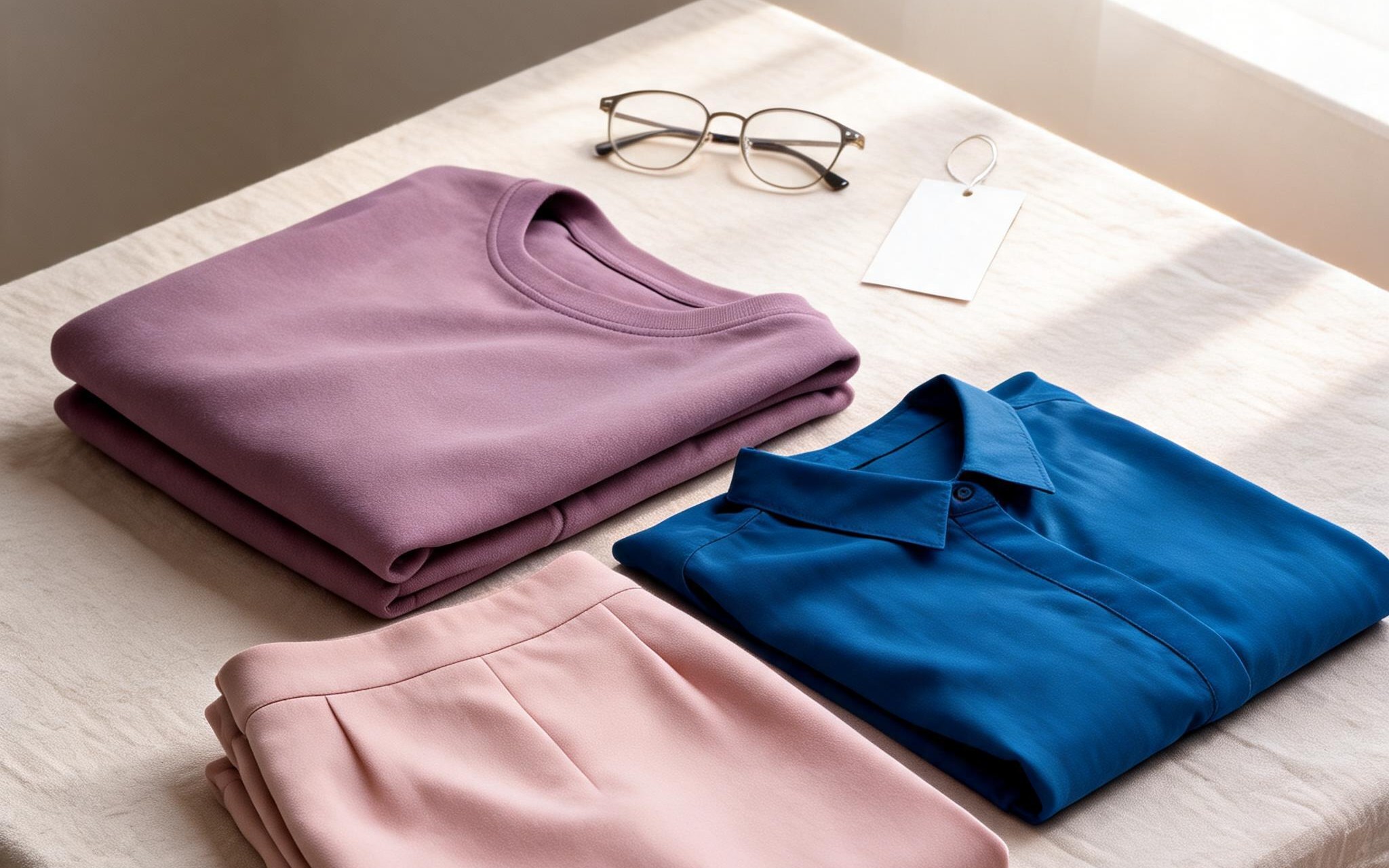
The rule is 3-3-3: three tops, three bottoms, three layers make twenty-seven outfits, and a wardrobe that small is the most sustainable thing most of us will ever own. These are three of the nine. All three are EU-made, all three are in stock in sizes S to XL or beyond today, and together they cost €198.97.


The cotton crew is the layer: a dusty mauve sweatshirt in cotton 90%, polyester 10%, in mauve, off-white and beige, sizes S to XL. It goes over the blouse in the evening and over a T-shirt on a bicycle. The wrap-front skirt is the bottom that moves: A-line, knee-length, in blush pink or teal, sizes S to XXL, polyester 95% with 5% spandex, so it does not crease in a pannier. The boat-neck blouse is the top: viscose 92%, in royal blue or black, S to XXL, a dolman sleeve that reads as dressed without being formal. Blue top, pink skirt, mauve layer is one outfit; swap the skirt for your own jeans and it is another.
Seventy pieces out of two thousand carry the made-in-EU tag. We would rather say that than round it up.
Where the 5% goes
5% of each sale goes to a cause you choose after ordering: CARE International, Cool Earth or Project Zero. It is calculated on the sale, not on what is left after costs, and it shows on the confirmation. That is the whole mechanism; there is no foundation with our name on it and no percentage that depends on a good quarter.
Create your avatar (free) and see any of these pieces on you before you decide. Lucy, our AI stylist, builds the look from what you tell her: the occasion, the weather, the colour you refuse to give up. If the piece you have in mind is not on this page, ask her; she can show any piece in the store on your avatar. Then play today's styling brief and share the card with a friend.
Makeover in the Magic MirrorAsk LucyPlay today's brief
Questions people ask before they buy
Is WowStore a sustainable fashion shop in Amsterdam? We are an online store based in Amsterdam with no physical shop. Seventy of the pieces in stock today are tagged made-in-EU; the rest come from partners outside the EU, and each product page says which.
Where do the pieces ship from? EU-made pieces are sent from inside the EU; the two shipments we have timed took five days (Poland to Eindhoven) and ten days (overseas partner to our Amsterdam hub). The estimate for each piece is on its product page.
What does it cost? Of 979 women's pieces in stock, half are under €52; 143 are under €30 and 74 are over €100. The three pieces on this page cost €198.97 together.
Can I return it? Yes, within 30 days.
Photographs marked "AI render" are AI-generated illustrations built from the real product photos; product images are the real pieces. Lucy, our stylist, is AI. Stock counts, prices and shipment timings are from the live catalogue and our own delivery log on 7 September 2026. 5% of each sale goes to a cause you choose.
What to wear to Dutch Design Week 2026: three looks, one rule, nine days on foot in Eindhoven
Women's fashion in Eindhoven: three looks for the city, sizes in stock, real prices, tried on you first
Related Posts

Herenkleding online: welke maten er deze week op voorraad liggen, wat het kost en hoe lang het duurt

Women's fashion in Eindhoven: three looks for the city, sizes in stock, real prices, tried on you first

What to wear to Dutch Design Week 2026: three looks, one rule, nine days on foot in Eindhoven

WowStore vs Zara: Honest Comparison (2026)

WowStore vs Shein: Honest Comparison (2026)

WowStore vs Primark: An Honest Comparison


